
Abstract 2026
Rivista Mineralogica Italiana > Abstract Articoli
Abstract ITALIAN MINERALOGICAL MAGAZINE nr. 1-2026 | ||||||
CHALCOPYRITE FROM TAVAGNASCO (TORINO, PIEDMONT, ITALY)  | This paper retraces the geological, mining, and collecting history of chalcopyrite from Tavagnasco (Pied- mont, Italy), one of the most significant localities in the Eastern Graian Alps for the study of sulfides. After a general introduction to chalcopyrite and the historical importance of cop- per, the geological framework of the area is outlined, placing Tavagnasco within the Sesia-Lanzo Zone of thWestern Alps, characterized by highgrade metamorphic rocks affected by Oligocene intrusions and a com- plex network of hydrothermal veins. The Tavagnasco mineralization is interpreted as a contact-type sulfide deposit, with a mineral assemblage dominated by chalcopyrite, pyrite, sphalerite, and galena, associated with quartz and carbonate minerals. Considerable attention is devoted to the historical context, from probable Roman-age mining activities to in- dustrial exploitation during the 19th and early 20th centuries. The paper also describes the modern “rediscov- ery” of the site beginning in 1983 and highlights the exceptional aesthetic quality of the chalcopyrite crystals, now regarded as among the finest from the Italian Alps, emphasizing the current scientific and historical significance of the Tavagnasco min- ing district. | |||||
THE MONTE VACCAREGGIO MINE (DOSSENA, BERGAMO PROVINCE, LOMBARDY, ITALY): NEW IDENTIFICATIONS FROM THE GORNO MINING DISTRICT  | The Monte Vaccareggio mine is lo- cated in the municipality of Dossena (BG), but, unlike the nearby Paglio Pignolino mining site, it has never gained significant attention in the mineralogical context of the Orobic Alps. In this contribution, the geolo- gy and mineralogy of this interesting deposit are detailed. This research allowed the collection of excellent spec- imens of pyromorphite, among the most beautiful found in Lombardy, as well as corkite, hinsdalite, rosasite, and linarite. Other notable mineral spe- cies identified at this locality include doyleite, fraipontite, hydrocerussite, kintoreite, and plancheite. In general, the Monte Vaccareggio mine exhibits distinctive geological features that set it apart from other mines in the Gorno district, such as the presence of phosphate lenses and a massive cop- per silicate mineralization (chrysocolla and plancheite) as well as Zn and Al minerals (fraipontite and doyleite). | |||||
THE LUNA PEGMATITIC DYKE (DORIO, LC): NEW MINERALOGICAL DATA  | The occurrence of four mineral species previously not reported from the Luna pegmatitic dyke (Dorio, Lecco Province, Lombardy) is here described, i.e.,graphite, graftonite, monazite-(Ce),and whiteite-(CaMnMn). Graphiteoccurs as greasy dark-grey tiny masses, often formed by aggregates of mm-sized spheres. Its identificationis based on qualitative chemical dataonly. Graftonite, the Fe-richest member of the graftonite group, occurs as honey-brown to greenish-brown, cm-sized, masses. It is worth noting that all previously analyzed samples labeled as “graftonite” actually corresponded to graftonite-(Ca). On the contrary, the studied sample from the Luna pegmatitic dyke has the empirical chemical formula (Fe0.90Ca(PO3.99)2, thus corresponding to graftonite. This is the first identification of graftonite from the Piona pegmatitic swarm. Monazite-(Ce) occurs as equant monoclinic green crystals within hydro- thermal cavities of the pegmatite. Its chemical formula is characterized by high U contents. Both morphological and chemical features of monazite-(Ce) from the Luna dyke are similar to those of the samples collected in the Olgias- ca-Malpensata occurrence. Finally, whiteite-(CaMnMn) forms yellowish prismatic crystals, less than 1 mm in size, in hydrothermal cavities. | |||||
AN HISTORICAL SPECIMEN OF DIOPSIDE FROM TESTA CIARVA (ALA VALLEY, PIEDMONT, ITALY)  | An historical specimen of diopside from the classic locality of Testa Ciar- va (Ala Valley, Piedmont, Italy) has been recently added to the collection of one of the authors of this paper (A.M.) and its history has been reconstructed. Indeed, the specimen was il- lustrated in a paper published in 1920 and dealing with the morphological crystallography of diopside. Probably, the specimen was originally collected by Johannes Strüver (1842-1915) at the end of the 1860s. Later, it be- longed to the Castagneri collection and was then acquired by Ferdinand Pierre-Joseph Gonnard (1838-1923) who donated it to the collection of the Faculty of Science of Lyon (France). In recent times, it belonged first to the Eric Asselborn collection and then to Tiziano Bonisoli, who sold it in 2023. | |||||
MUSEUM OF NATURE AND HUMANKIND, PADUA. THE “A. GUASTONI” MINERALOGICAL SECTION  | An historical specimen of diopside from the classic locality of Testa Ciar- va (Ala Valley, Piedmont, Italy) has been recently added to the collection of one of the authors of this paper (A.M.) and its history has been recon-structed. Indeed, the specimen was il- lustrated in a paper published in 1920 and dealing with the morphological crystallography of diopside. Probably, the specimen was originally collected by Johannes Strüver (1842-1915) at the end of the 1860s. Later, it be- longed to the Castagneri collection and was then acquired by Ferdinand Pierre-Joseph Gonnard (1838-1923) who donated it to the collection of the Faculty of Science of Lyon (France). In recent times, it belonged first to the Eric Asselborn collection and then to Tiziano Bonisoli, who sold it in 2023. | |||||
Abstract ITALIAN MINERALOGICAL MAGAZINE nr. 2-2026 | ||||||
EPIDOTE – THE SPECIMENS FROM EASTERN LIGURIA (ITALY)  | The occurrence of epidote from Eastern Liguria has been known since, at least, the end of the 19th century. However, only since the 1960s, mineral collectors have begun to collect mineral specimens from the Cassagna mine (Graveglia Valley, Genoa Province). Epidote is hosted within veins cutting pillow lavas of basaltic composition. The most important localities are the following ones: i) Bonassola and Framura (La Spezia Province): epidote vein systems are very common but mineral specimens are of low quality. Crystal size is usually very small, even if crystals are very shiny. ii) Bracco Pass (La Spezia and Genoa Provinces): epidote forms low-quality specimens, of local interest only. iii) Bargone, Campegli, and Masso (Petronio Valley, Genoa Province): among the most important localities, the farm road between Bargone and Maissana has to be remembered. From this area, aesthetic druses of dark and shiny epidote crystals, up to 0.5 cm in size, associated with calcite, prehnite, “pumpellyite”, and quartz, were collected. Other findings were performed at Barche (or Pian delle Barche), in association with quartz, and on the slopes of Monte Tregin. At the end of the 1970s, epidote was collected at the Sant’Elena quarry, in dark green and shiny crystals, up to 0.5 cm across, associated with quartz; pluricentimetric druses of dark green crystals, up to more than 5 mm, were collected at the Sant’Elena mine (known also as Campegli mine). Epidote veins were identified close to San Pietro Frascati, and interesting radial aggregates were observed on the slope of Monte Pù, following a small landslide. Small epidote crystals were also found in the Acquafredda quarry, near Masso, and along the Frascarese stream. iv) Zeri, Pontelagoscuro, Gambatesa, and the right bank of the Graveglia stream (Genoa Province): epidote vein systems near Zerli were the first to be sampled by mineral collectors during the 1970s, thanks to the road construction. In the following years, other nice specimens of epidote were collected at Pontelagoscuro, where nice specimens with epidote and quartz crystals were discovered. Small epidote crystals were observed in basalts cropping out in the abandoned quarry of Monte Comarella, above the Gambatesa mine, and small crystals were also collected in the underground workings of this latter locality. Finally, the specimens of epidote from Arzeno, Monte Biscia, and Monte Chiappozzo, have a negligible interest. v) Molana quarry, Molinello, Nascio, Morella, Cassagna, and the left bank of the Graveglia stream (Genoa Province): small crystals of epidote are known from the now-abandoned Molana quarry. Some other speci- mens were found in the upper stopes of the Molinello mine, near the con- tact between the Diaspri and Basalts formations. Similar veins were later found in the Costa Morella, near Nascio. Here, in 2001, a cavity of 1 × 1 × 0.2 m in size was found and it provides a large number of good specimens of epidote and quartz. Other findings have been performed around the small hamlet of Nascio, where crystals up to 1 cm have been collected, in association with quartz, sometimes in crystals up to 10 cm. Small crystals of epidote are known from the Cassagna mine, Monte Bianco, and Statale. Crystals up to 3 mm are known in the Monte Capra area. vi) Monte Aiona, Sturla Valley and Aveto Valley (Genoa Province): on the slopes of Monte Aiona there are small crystals of dark green epidote, associated with quartz, “adularia”, prehnite, albite, and “pumpellyite”. In the Sturla Valley, epidote was found in an old abandoned quarry near Squazza, as small dark green crystals, associated with calcite, quartz, and “adularia”. Other small crystals have been collect- ed in the valley behind the Abbazia di Borzone. Finally, in the Aveto Valley, there are some localities where epi- dote can be found in association with quartz and prehnite. | |||||
MINERALS FROM THE RIO DEI RONCHI (CIME BIANCHE DI TELVES, VIPITENO, BZ)  | In the Italian Alps, about 15 km southeast of the Brenner Pass, along the southern slope of the Cime Bi- anche di Telves-Telfer Weißen (Ridanna-Ridnaun Valley, Vipiteno-Sterzing, Bolzano-Bozen, Italy), just east of the much better known mining district of Monteneve-Schneeberg, there are documented similar lead-zinc de- posits that were mined for silver-bear- ing galena between the end of the 15th century and the end of the 18 cen- tury. The presence of still clearly visi- ble mining waste dumps near the Rio dei Ronchi-Runggenbach and their relative ease of access facilitated the mineralogical sampling. The mineralization is represented by a complex polymetallic occurrence of Zn, Pb, Ag, Cu, Fe, Sb, As, Co, Ni, Bi, and Au, with dominant sphalerite, gale- na, pyrrhotite, and chalcopyrite; this ore deposit is interpreted as a VMS, hosted in the Ötztal-Breonie fault of the Australpine Metamorphic Basement. This tectonic unit is represented by sandy and clayey protoliths,metamorphosed into biotite-muscovite paragneisses, with intercalated quartzite-muscovite orthogneisses, amphibolites, amphibolite gneisses.In addition, there are quartzite-muscovite graphitic micaschists, sometimes garnet-bearing. The latter, sometimes accompanied by graphitic black schists or carbonate facies, are associated with the sulfide ore deposits that are the target of the mining activity. In addition to the species constituting the primary mineralization already described in the scientific literature of the 1970s and 1980s, several supergene minerals, some of which are quite rare, have been documented in recent years, bringing the total number of identified species to about 70. There are three new reports for the Trentino-Alto Adige region (descloizite: black, shiny, lanceolate crystals with dark brown reflections; glaucodote: pseudocubic crystals with a metallic lustre, gray-yellowish; spangolite: light blue or, more rarely, green tabular crystals) and nine for the province of Bolzano [beaverite-(Cu): very shiny microcrystalline crusts ranging from yellow to reddish-brown; bindheimite: poorly formed crystalline aggregates or minute lamellar or acicular crystals with a greasy lustre; brianyoungite: milky crusts or, rarely, very pale yellow globules; caledonite: prismatic crystals grouped in blue spherules or radiating aggregates; duftite: apple green crusts covering cerussite crystals; namuwite: light blue rosettes consisting of minute pseudohexagonal crystals; rams- beckite: dark green to blue crystals, very shiny, squat and pseudocubic, or with a typical rhombic outline; schu- lenbergite: blue-green, lamellar crystals with a pseudohexagonal outline grouped in parallel clusters; valent- inite: colorless or pale yellow crystals, rarely single, often in aggregates of a few individuals or in elegant fans]. Among the most common species forming nice micromount specimens, one can remember the following ones: linarite, in shiny prismatic crystals of electric blue color often associated with brochantite (very shiny bottle green crystals), anglesite (crystals with highly variable morphology, mainly prismatic with chisel or tabular termi- nation), cerussite (white crystals usually elongated or in stocky, striated individuals, sometimes in characteristic V-shaped twins); aurichalcite, in white to light blue spherules or mammillary aggregates, often associated with hemimorphite (clear, colorless, flattened or lanceolate crystals, often grouped in rosettes or densely clus- tered to form spherules) and smithsonite (rounded crystals or aggregates in sheaves, ranging from pure white to yellow-brownish); finally, langite, in light blue lamellar or stocky crystals with a pseudocubic habit, and theisite, represented by green globular aggregates. | |||||
VANADINITE: A NEW FINDING FROM THE LAMA DELLO SPEDALACCIO (MS)  | The area close to the small village of Sassalbo and the Ospedalaccio Pass (Fivizzano, Massa-Carrara Province, Tuscany, Italy) is known for the presence of some mineral occurrences, related to Triassic evaporites and to Variscan metamorphic rocks. Less known is the presence of a galena mineralization hosted in the Macigno Formation. in the southern slope of Monte Alto and known since the beginning of the 1980s. In September 2010, a field sampling aiming at collecting specimens of galena allowed the first discovery of small crystal aggregates of vanadinite in small vugs of calcite veins. Several years later, further research performed along the Acqua Torbida stream improved the knowledge about the mineralogy of the area. Calcite veins rarely hosted sulfideminerals, represented by chalcopyrite, galena and pyrite. The latter is usually deeply oxidized and replaced by goethite. Chalcopyrite forms crystalline masses, up to 1.5 cm, sometimes associated with malachite. Galena occurs as cubic crystals, usually embedded in calcite and only very rarely free in small vugs of calcite veins. They are usually coated with cerussite crystals, and they are often associated with small needles of orange-reddish vanadinite. This latter mineral occurs also in prismatic hexagonal crystals, less than 1 mm in length. Their unitcell parameters are a = 10.302(2), c = 7.365(2) Å, V = 676.9(3) Å3 and the empirical chemical formula ca be written as Pb [(VAs )O ] Cl. | |||||
Abstract ITALIAN MINERALOGICAL MAGAZINE nr. 3-2026 | ||||||
SENANDORITE: FIRST FINDING IN THE VUGS OF THE MARBLE FROM THE ALPI APUANE (TUSCANY, ITALY) 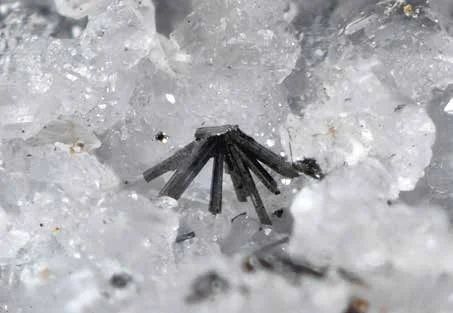 | The Alpi Apuane metamorphic complex hosts several systems of hydrothermal veins that are the classic occurrence of several sulfosalt species. Among these occurrences, the cavities of the Lower Jurassic marbles are well-known among mineral collectors for the presence of well-crystallised specimens. Even if the first sulfosalt species was uncertainly reported at the beginning of the 20th century (i.e., a possible tetrahedrite-group mineral), followed by the first actual identification of jordanite at the end of the 1960s, the modern mineralogical research started in 1974, when Prof. Orlandi began the systematic investigation of the mineralogy of the cavities of the marbles. Since then, numerous species have been identified, and three new sulfosalts (i.e., moëloite, disulfodadsonite, and bernarlottiite) were discovered. Usually, sulfosalts from the marble cavities are primarily Pb and Cu sulfoantimonites or sulfoarsenites, while other elements are rare. Notably, despite the relatively Ag-rich nature of some hydrothermal vein systems of the region, Ag minerals were previously unknown from the marble cavities, the only exception being izoklakeite where Ag occurs as a minor substituent for Pb. The identification of senandorite is thus the first Ag-sulfosalt ever documented within the Apuan marble cavities. This mineral has been identified in two samples collected in March 1983 in the Ceragiola marble quarries where it occurs as black prismatic crystals, up to 0.5 mm in length, associated with zinkenite and yellow sphalerite. Its identification is based on single-crystal X-ray diffraction and qualitative EDS chemical analysis. | |||||
MAGNESITE ORE DEPOSITS FROM MONTI LIVORNESI (TUSCANY, ITALY). HISTORY AND MINERALOGY 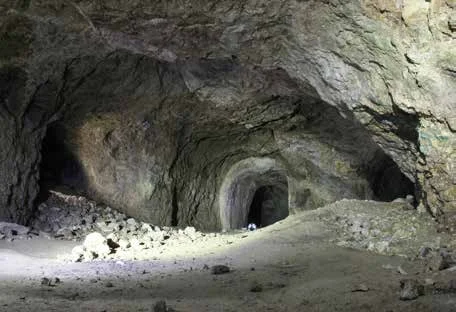 | The area of the Monti Livornesi (Tus- cany, Italy) is known for the occurrence of some mineral specimens well repre- sented in several mineral collections, e.g., pink dawsonite from the Valle Benedetta, baryte from Calafuria, and melanophlogite from Fortullino. Start- ing in 2023, researchers from the Grup- po Geo-Mineralogico Livornese initiated fieldwork to gather further data on the region’s magnesite deposits, leading to the discovery of new melanophlogite outcrops and highly luminescent do- lomite specimens. The magnesite ore deposits are located within the mu- nicipality of Rosignano Marittimo in the southern sector of the Monti Livornesi. This area represents a struc- tural high bounded by two regional transcurrent fault systems: the Livor- no-Empoli line to the north and the Rosignano-Pomaia line to the south. The stratigraphic sequence features the deepest unit, the Tuscan Nappe (rep- resented by the Macigno formation), overlain by Ligurian units containing discontinuous lenses of serpentinized ultramafic rocks, gabbros, and basalts. The magnesite deposits form veins and stockworks hosted within hydro- thermally altered serpentinites. Recent studies suggest a three-steps genetic model: i) tectonic processes embedded serpentinite lenses within impermeable argillitic lithologies, creating an epithermal aquifer from meteoric waters; ii) NE-SW transcurrent faults allowed the ascent of CO2-rich mantle fluids; and iii) the opening of localized fractures triggered a sudden pressure drop, causing the boiling of the hydrothermal fluids, releasing CO2, raising pH levels, and resulting in the instant precipitation of cryptocrystalline magnesite. The textures of magnesite ores suggest that the material was probably originally deposited as hydrated magnesium carbonates (such as hydromanesite) and subsequently replaced by magnesite. Biostratigraphic data seals the age of this tectonic and mineralizing activity to prior to ~3.5 Ma (Early Pliocene). The exploitation of magnesite occurred primarily during the first half of the 20th century. Prior to World War I, Italy imported most of its magnesite from Austria and Greece. When Italy entered the war against Austria in 1915, these imports ceased. Magnesite suddenly became a highly strategic raw material needed to manufacture basic refractory bricks used to line Martin-Siemens and Bessemer steel furnaces for wartime production. Luckily, in 1913 magnesite lodes were discovered in the area of Botro Massaccio and the entrepreneur Attilio Gotti founded in 1914 the Società Magnesite, initiating extraction at this locality. The mine featured an extensive network, including a first-level haulage tunnel stretching over 500 meters by 1916. The company also built a refractory brick factory on the coast at Le Forbici. Magnesite was transported to the plant via an aerial cableway, and a second cableway carried the finished bricks to the Castiglioncello railway station. The plant became inactive in 1924 and was later sold in 1932 to Edoardo Mascagni (son of composer Pietro Mascagni) to produce motorcycles, before changing hands multiple times post-WWII. In 1916, the Società Gino Lavelli began to mine magnesite in the Campolecciano mine. The steel company Società Terni gradually acquired full ownership by 1940. This deposit was geographically larger than Botro Massaccio, operating multiple open-pit and underground sites (Mammellone, San Quirico, Speranza, Crocino, Acqua Padula, and Punta Gagliarda). Extracted ore was moved via a 4 km Decauville railway to Fortullino. At the Punta Gagliarda stope (Macchia Escafrullina), mining focused not only on magnesite but also on iron sulfides. Operations faced severe technical challenges, like the massive water inflows into the tunnels that required continuous pumping, and the rapid oxidation of iron sulfides upon exposure to air, which generated extreme temperatures capable of igniting timber sets. National magnesite production peaked between 1917 and 1920. Post-war, demand plummeted, and the local ore’s high silica and calcium impurities made it less competitive against resumed Austrian and Greek imports. While autarkic policies triggered a brief revival in the late 1930s, all mining operations in the region permanently shut down in 1943 due to WWII military restrictions and vein depletion. Another interesting geosite is the Bucafonda Quarry, near the hamlet of Gabbro. This site never saw industrial magnesite exploitation. Instead, until the 1970s, the Fratelli De Ranieri company utilized helical wire cutting techniques to extract highly valued ornamental green “marble” (serpentinite) blocks, which were processed in Querceta (Lucca) or export ed internationally. Scientific interest in the region dates back to the early 19 th century. Early geologists like Gian Battista Brocchi (1817) and Giovanni Capellini (1874) initially misidentified dolomite and magnesite as prehnite. In 1913, Giovanni D’Achiardi corrected these identification, reporting the presence of dolomite and magnesite associated with chalcedony and opal. In the mid-20th century, Giorgio Marinelli (1955) published a detailed mineralog- ical investigation of Macchia Escafrul- lina, describing its pisolitic magnesite, sulfides, and secondary sulfates. The boom of amateur mineral collecting in the late 1960s eventually led to the of- ficial identification of melanophlogite in the region by Grassellini Troysi and Orlandi (1972). Currently, the following mineral species are reported from the magnesite lodes and country rocks: Aragonite: found as colorless or milky flattened crystals up to 7-8 cm long, arranged in fan-like aggregates along rock fractures at the Bucafonda quarry. Calcite: found as saddle-like aggregates on dolomite or as small white rhombohedra on dolomite. Cinnabar: it occurs as small crys- talline “strawberry-like” aggregates (up to 2 mm), red coatings, or rare sub-millimetric acicular crystals. It is typically associated with dolomite and melanophlogite. “Copiapite”: yellow efflorescences re- sulting from iron sulfide alteration. It can be classified as magnesiocopiapite. Dolomite: it is one of the most abundant minerals. It forms white to greenish rhombohedral and lenticular crystals (up to 3 cm) in geod- ic cavities. At Bucafonda and Botro dell’Arancio, it forms green-to-brown banded globular/stalactitic aggregates that exhibit a pronounced photo minescence under ultraviolet light. Epsomite: colorless acicular crystals formed via the interaction of sulfuric acid (from oxidizing sulfides) with magnesite. Gypsum: sub-millimetric tabular colorless crystals associated with “co- piapite”. Halloysite: found within the earthy, blue-green clay materials historically dubbed “chrome ochres.” Hexahydrite: it occurs as dehydra- tion product of epsomite, as white fibrous aggregates. Magnesite: it usually occurs as compact, porcelain-like white-to-cream cryptocrystalline masses. It sometimes exhibits polyhedral pisolitic textures featuring concentric internal structures. It rarely forms lustrous, light-brown pseudo-hexagonal prismatic crystals up to 5 mm long. Manganese Oxides: present as com- mon, uncharacterized black dendrites along rock fracture planes. Marcasite/Pyrite: intimately associated iron sulfide dimorphs. Due to their microcrystalline nature, they oxidize rapidly, making well-preserved specimens highly rare. They have been verified via XRD as millimetric bipyramidal crystals embedded in chalcedony or resting on dolomite. Melanophlogite: A rare silica clathrate abundant at the Mammellone stope of the Campolecciano mine, where it forms as lustrous, dewberry-like glassy droplets or pseudocubic crystals under 1.5 mm in size. Micro-Raman spectroscopy shows that gas molecules trapped within the structural cages vary by locality. At certain sites (e.g., Il Poggione and Tane al Leccio), quartz has entirely replaced melanophlogite. Melanterite: pale blue efflorescences. Montmorillonite: a striking emerald-green clay mineral originally mis classified in local literature as volkonskoite. Re-evaluation of the chemical formula shows it is an intermediate term between dioctahedral and trioc- tahedral smectites, properly classified as montmorillonite. Opal: found as colorless globular aggregates or resinous brown coatings on fractured serpentinite, sometimes acting as the hosting matrix for melanophlogite. Quartz: relatively rare as isolated crystals, but widespread as chalced- ony (often light blue and beautifully banded), in some cases replacing lenticular dolomite crystals. | |||||
VALSASSINA (LECCO PROVINCE, LOMBARDY, ITALY). MEMORIES OF SOME FIELD-COLLECTOR FRIEND | The Valsassina valley (Lecco Province, Lombardy, Italy) is one of the most important mining areas in the Prealps. It is renowned for both its economic and social development driven by iron- working, and its highly significant, rare mineral species. The most important ore bodies are formed by hydrothermal veins formed during the Permian exten- sional phase, which accompanied the fragmentation of Pangea and the open- ing of the Tethys Ocean. Between the 1970s and 1990s, Giancarlo Valsecchi and Luigi Possenti played a pioneering role in systematically rediscovering the valley’s forgotten mining sites. Their approach brought scientific attention back to historical locations, most no- tably the Pra Piazzo silver mine near Introbio. Beyond mentoring a new generation of collectors and geology students (including Paolo Giovanni Biffi and the author P.G.), they collabo- rated with archaeologist Marco Tizzoni on his historical publications. In recent years, collaboration with Luigi Possenti led to the identification of several mineral phases previously unrecorded in Valsassina. Pyrargyrite and pyrostilpnite specimens found by these mineral collectors were analyzed by Professor Paolo Orlandi at the University of Pisa. The Pra Piazzo vein is one of the most mineralogically complex bodies and it is hosted within the Monte Cabianca volcanic rocks heavily altered by hydro- thermal processes. During the late-stage evolution of the ore body, a network of quartz + dolomite + baryte + siderite veins was formed, hosting several sulfides (acanthite, diaphorite, stephanite, pyrargyrite) and native silver. | |||||
NEW ITALIAN MINERALS. THE CONTRIBUTION OF PAOLO ORLANDI  | Italy ranks fourth globally for the number of new mineral species dis- covered within its territory, trailing only the United States, Russia, and Germany. This remarkable geodiversity stems from varied geological conditions involving temperature, pressure, and chemical composition. However, this scientific wealth is also the result of a long-standing tradition of research. Crucially, around 80% of Italian type-specimens approved since 1959 were provided to scientists by amateur collectors. Professor Pao- lo Orlandi's 50-year career exemplifies this synergy: almost all of the 60 mineral species he described were brought to light through close collaboration with passionate collectors. Throughout his career, Orlandi fo- cused on specific geological environ- ments across Italy. In the late 1970s, his work on volcanic ejecta from Pitig- liano (Tuscany) led to the discovery of new cancrinite-group feldspathoids, including liottite, franzinite, and tus- canite. Subsequent research on vol- canic materials yielded pitiglianoite, marinellite, and quadridavyne, the latter occurring in Vesuvian ash from the 1906 eruption. Turning his fo- cus to active fumaroles on Vulcano Island, Prof. Orlandi collaborated on characterizing rare halides and sulfohalides, such as vurroite, hep- haistosite, knasibfite, thermessaite, and demicheleite-(Br). Piedmont also benefited from Orlandi’s expertise, contributing to nine of the region's 55 type-locality species. Early col- laborations yielded canavesite from Brosso, followed by rare scandium- and REE-bearing silicates like cascan- dite, jervisite, scandiobabingtonite, and calcioancylite-(Nd) from the granite cavities of Baveno. His studies on manganese deposits and hydrothermal veins resulted in the descrip- tions of ardennite-(V), lavoisierite, gramaccioliite-(Y), and the lead-sil- ver-antimony sulfosalt tubulite. The Apuan Alps represented perhaps the most fertile ground for Orlandi's discoveries, particularly regarding complex hydrothermal sulfosalt min- eralization. Partnering with French researchers, his team identified over twenty new sulfosalts. Discoveries included grumiplucite, moëloite, disulfodadsonite, and bernarlottiite. Studies at the Buca della Vena mine brought to light scainiite, the first natural lead-antimony oxy-sulfosalt, alongside pillaite, pellouxite, rouxelite, and marrucciite. Later inves tigations at the Pollone and Monte Arsiccio mines unveiled parasterryite, carducciite, meerschautite, and Italy's unique thallium-sulfosalt assemblage, which includes boscardinite, protochabournéite, andreadiniite, and arsiccioite. Beyond sulfosalts, the Apuan Alps revealed extraordinary oxide, sulfate, and carbonate diversity. Buca della Vena hosted apuanite and versiliaite (rare iron-antimony thio-oxides), dessauite-(Y), mapiquiroite (found also at the Monte Arsiccio mine), oxycalcioroméite, and allanite-(La). Pyrite alteration lead to the crystallization of volaschioite, whereas secondary assemblages from the marble cavities allowed the discovery of carraraite, zaccagnaite, and zincalstibite. Orlandi's research extended to other Tuscan geosites as well. In the Elba Island, he contributed to the identification and description of uranopolycrase, from vugs of pegmatitic dykes, and magnesio-lucchesiite, within fractures of metabasite. In the antimony deposits of Pereta, he contributed to describing peretaite and coquandite. Finally, Orlandi's national network of collectors enabled major break throughs elsewhere. Collaboration in Veneto led to the discovery of the secondary copper sulfate montetrisaite. In Sardinia, extensive work on the bismuth-molybdenum deposit of Su Seinargiu produced nine new species: Bi-Mo minerals like sardignaite, gelosaite, mambertiite, suseinargiuite, and tancaite; the exceptional thorium halide cabvinite and the thorium molybdates ichnusaite and nuragheite. Sarrochite was the last chapter of this long journey in the Italian mineralogy. | |||||
Abstract ITALIAN MINERALOGICAL MAGAZINE nr. 4-2026 | ||||||
